$4M

Soft Cap

$5M

Hard Cap

46,000

Investors

4.1/5

ICO Ranker

4.6/5

ICO Track

4.3/5

ICO Holder

aboutimg5

About The MI Token

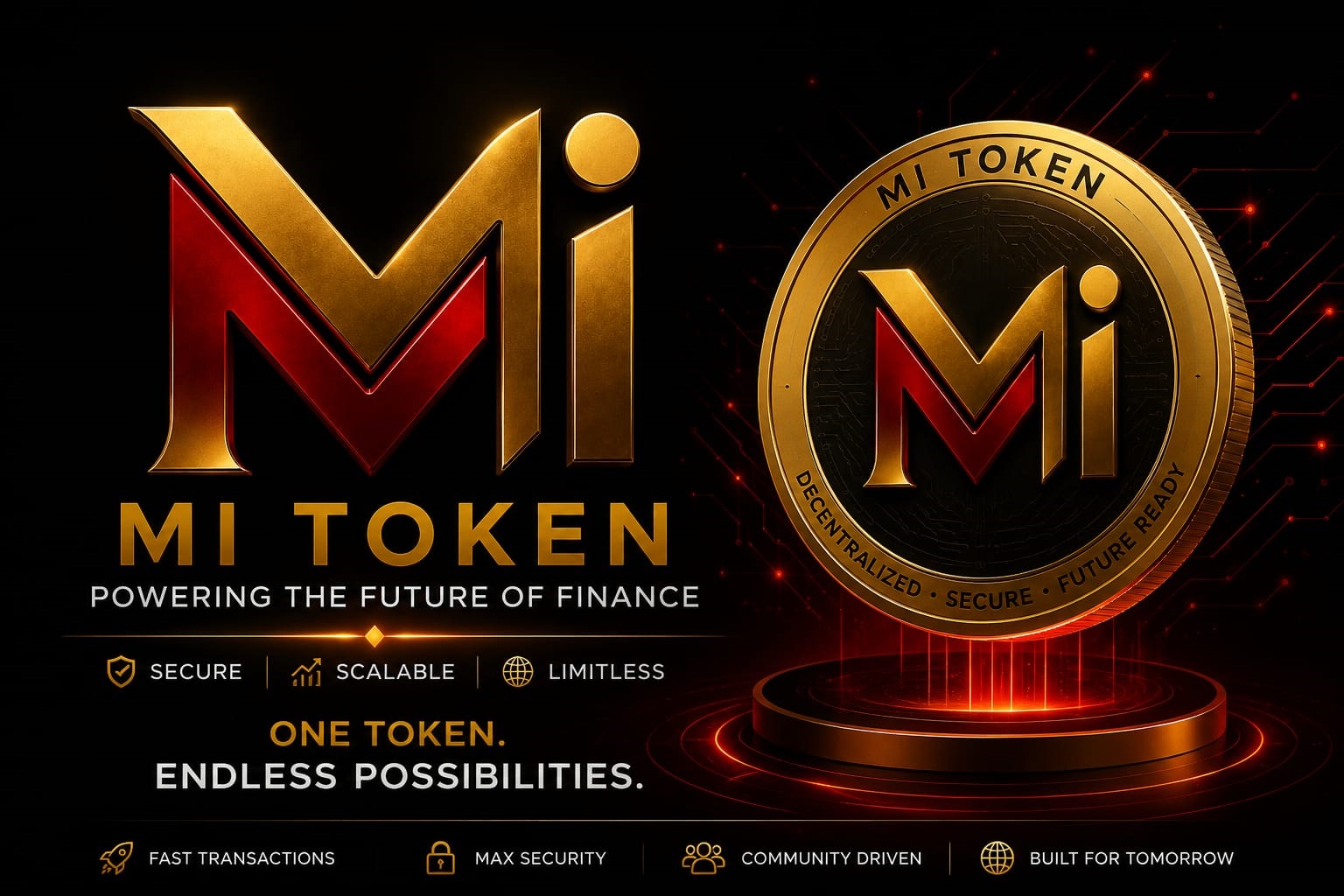
MI Token is one of the most transformative technologies since the invention of the Internet. MI Token stands firmly in support of financial freedom and the liberty that Bitcoin provides globally for anyone to voluntarily participate in a permissionless and decentralized network.

which empowers people to not be marginalized by governments and financial institutions. Bitcoin is freedom.If you are going to use a passage of Lorem Ipsum, you need to be sure there isn't anything embarrassing hidden in the middle of text.

Table of Contents

Frequently asked questions (FAQ) or Questions and Answers (Q&A), are listed questions and answers, all supposed to be commonly asked in some context

Mi Token is envisioned as a community-centered decentralized finance ecosystem designed around accessibility, transparency, user participation, and practical digital utility. The project seeks to connect users with blockchain-enabled financial tools while progressively developing an ecosystem that may include token utility, staking, governance, wallet integrations, decentralized exchange access, community incentives, and cross-chain functionality.

The Mi Token strategy follows a phased development model. Community formation and education precede technical deployment; smart-contract development, security review, ecosystem integrations, liquidity preparation, and token launch follow in later phases. This sequencing is intended to prioritize sustainable infrastructure over short-term speculation.

Mi Token’s guiding principles—Connect, Empower, Elevate—represent its ambition to connect a global community, empower participants with decentralized tools, and elevate blockchain utility through transparent and accessible products.
Blockchain networks have enabled programmable digital ownership and peer-to-peer financial applications that can operate without relying exclusively on traditional intermediaries. Decentralized finance has expanded this model through smart contracts, decentralized exchanges, liquidity protocols, staking mechanisms, and community governance.

Mi Token proposes an ecosystem-oriented approach in which a digital token serves as an access, participation, incentive, and governance layer across compatible applications. The architecture described in this document is a target design and development framework. Features described as planned or proposed are not representations that such systems are already deployed.

This whitepaper presents the project's vision, proposed ecosystem, technology principles, token utility framework, security model, governance direction, roadmap, and risk considerations.
Vision: To build a decentralized financial ecosystem that empowers people worldwide through transparency, security, accessibility, community participation, and meaningful utility.

Mission: Mi Token aims to develop an interconnected ecosystem where users can access decentralized tools through a coherent experience. The project intends to combine community development, audited smart-contract infrastructure, liquidity access, staking, governance, wallet connectivity, and future cross-chain capabilities.

The project is guided by four principles: global community, financial empowerment, decentralization, and trust through transparency. These principles are design objectives rather than guarantees of financial outcomes.
Digital assets introduced a model of programmable value transfer. Smart-contract platforms subsequently enabled decentralized applications, including exchanges, lending markets, liquidity pools, digital collectibles, and governance systems.

Despite rapid innovation, adoption remains constrained by fragmented user experiences, technical complexity, security risks, inconsistent liquidity, and speculative token designs with limited sustainable utility. Mi Token seeks to address these challenges through phased development, clear utility objectives, community education, interoperable integrations, and transparent governance.

The opportunity for Mi Token is therefore not simply to issue another tradable asset, but to build an ecosystem in which participation and utility can grow alongside technical maturity.
The decentralized-finance landscape faces several recurring challenges. Users often navigate multiple wallets, networks, interfaces, and protocols. New participants may struggle to understand transaction fees, approvals, slippage, liquidity, staking risks, bridges, and smart-contract permissions.

Token ecosystems can also suffer when incentives are designed primarily around short-term price appreciation. Unsustainable emissions, weak treasury controls, concentrated ownership, insufficient security review, and unclear governance can undermine long-term confidence.

Mi Token’s proposed approach is to prioritize understandable user experiences, transparent token design, staged utility deployment, security controls, community participation, and integrations rather than attempting to replicate every DeFi service internally.
The Mi ecosystem is designed as a modular framework. The Mi Token acts as the ecosystem asset, while applications and integrations provide specific functions. Proposed modules include wallet connectivity, decentralized exchange access, staking, community rewards, governance, treasury management, partner integrations, NFT/Web3 integrations, and cross-chain support.

A modular architecture allows components to evolve independently. For example, governance can mature from community signaling to structured on-chain voting, while liquidity can expand across approved venues as adoption develops.

Users should retain control of self-custodied assets whenever supported by the relevant application. Any externally integrated protocol remains subject to its own technical, market, and governance risks.
Potential Mi Token utility is designed around ecosystem participation rather than a promise of investment return. Subject to technical implementation, legal review, governance approval, and product availability, utility may include staking participation, governance voting, ecosystem rewards, access benefits, partner incentives, community programs, and compatible application functions.

Utility should be introduced progressively and measured against security, sustainability, regulatory requirements, and user demand. The project should avoid creating artificial utility solely to encourage trading volume.

Final rights attached to the token must be defined in deployed smart contracts and applicable legal documentation. Holding Mi Token should not, by itself, be represented as ownership of a company, guaranteed income, or entitlement to profits unless a legally compliant structure explicitly provides otherwise.
Mi Token is intended to use established blockchain standards and audited smart-contract patterns rather than unnecessary protocol complexity. The final deployment network, token standard, contract addresses, administrative controls, and upgrade model must be publicly documented before launch.

The target architecture consists of: a token contract layer; treasury and distribution controls; staking and rewards modules where implemented; governance contracts; liquidity and DEX integrations; wallet/application interfaces; analytics/indexing services; and optional interoperability components.

Critical administrative privileges should be minimized. Where operational control is necessary, multisignature authorization, time delays, role separation, transparent event logs, and governance oversight should be considered.

Implementation Notes


Final implementation parameters must be validated against deployed smart contracts, independent audits, governance approvals, and applicable legal requirements. Technical specifications in future revisions should include verified contract addresses, network identifiers, role permissions, upgrade controls, and public repositories where applicable.
Smart contracts form the programmable execution layer of the proposed ecosystem. Contracts should be separated by responsibility to reduce complexity and improve auditability.

A token contract manages balances and transfers according to the selected standard. Treasury contracts can manage allocated ecosystem reserves. Staking contracts, if deployed, can account for deposits and rewards. Governance contracts can record proposals and voting outcomes. Distribution and vesting contracts can enforce time-based allocations.

Before production deployment, contracts should undergo testing, independent security review, deployment verification, and public documentation. Any upgradeability mechanism should clearly disclose who can authorize upgrades and under what conditions.

Implementation Notes


Final implementation parameters must be validated against deployed smart contracts, independent audits, governance approvals, and applicable legal requirements. Technical specifications in future revisions should include verified contract addresses, network identifiers, role permissions, upgrade controls, and public repositories where applicable.
Security is a continuous process rather than a one-time certification. The Mi Token security framework should combine preventive controls, independent review, operational safeguards, monitoring, and incident response.

Security is a continuous process rather than a one-time certification. The Mi Token security framework should combine preventive controls, independent review, operational safeguards, monitoring, and incident response.

Users must also understand risks outside the core contracts, including compromised wallets, phishing, malicious approvals, bridge vulnerabilities, oracle failures, third-party protocol exploits, and market manipulation.

Implementation Notes


Final implementation parameters must be validated against deployed smart contracts, independent audits, governance approvals, and applicable legal requirements. Technical specifications in future revisions should include verified contract addresses, network identifiers, role permissions, upgrade controls, and public repositories where applicable.
Mi Token intends to support standard compatible wallets rather than forcing users into a custodial model. A future Mi-branded interface or wallet integration may simplify balance viewing, token transfers, staking access, governance participation, and ecosystem discovery.

Wallet design should emphasize transaction clarity. Users should be able to understand what they are signing, which contract they are interacting with, and what permissions are being granted.

Private keys and recovery phrases should never be requested by project administrators. Educational materials should reinforce safe wallet practices and official contract verification.
Decentralized exchanges can provide permissionless market access through smart contracts and liquidity pools. Mi Token’s liquidity strategy should prioritize transparent pool creation, appropriate liquidity depth, clear fee structures, and responsible treasury controls.

Initial liquidity parameters—including trading pair, liquidity allocation, lock or management structure, and supported venue—must be finalized before launch and disclosed publicly.

Liquidity provision involves risks such as impermanent loss, volatility, smart-contract failure, and market manipulation. Mi Token should not describe liquidity availability or future exchange listings as guaranteed until formally confirmed.
Staking can encourage long-term ecosystem participation when incentives are economically sustainable. A proposed Mi staking framework may allow eligible token holders to commit tokens to defined smart contracts and receive rewards according to published rules.

Reward rates should not be marketed as guaranteed returns. Parameters may depend on reward pools, participation, duration, governance decisions, and ecosystem economics. Excessive emissions can dilute token holders and weaken long-term sustainability.

Any staking design should clearly disclose reward sources, lock periods, withdrawal rules, smart-contract risks, and whether rewards are fixed, variable, or discretionary.
Mi Token envisions progressive community governance. Early governance may use community consultation and transparent project administration. As the ecosystem matures, selected decisions may transition to token-based proposals and voting.

Potential governance subjects include ecosystem grants, treasury initiatives, parameter changes, partnerships, incentive programs, and approved product integrations. Critical security functions may require additional safeguards beyond simple majority voting.

A mature governance system should address quorum, proposal thresholds, delegation, voting periods, emergency controls, conflicts of interest, and concentration of voting power.

Implementation Notes


Final implementation parameters must be validated against deployed smart contracts, independent audits, governance approvals, and applicable legal requirements. Technical specifications in future revisions should include verified contract addresses, network identifiers, role permissions, upgrade controls, and public repositories where applicable.
The ecosystem treasury is intended to support long-term development rather than short-term discretionary spending. Treasury categories may include technology development, security, liquidity initiatives, ecosystem incentives, partnerships, operations, community growth, and strategic reserves.

Final treasury allocation percentages have not been supplied for this draft and should be inserted only after formal approval. Publishing allocation rules, vesting conditions, authorized wallets, and material treasury movements can improve transparency.

Where practical, treasury custody should use multisignature controls and documented approval processes.
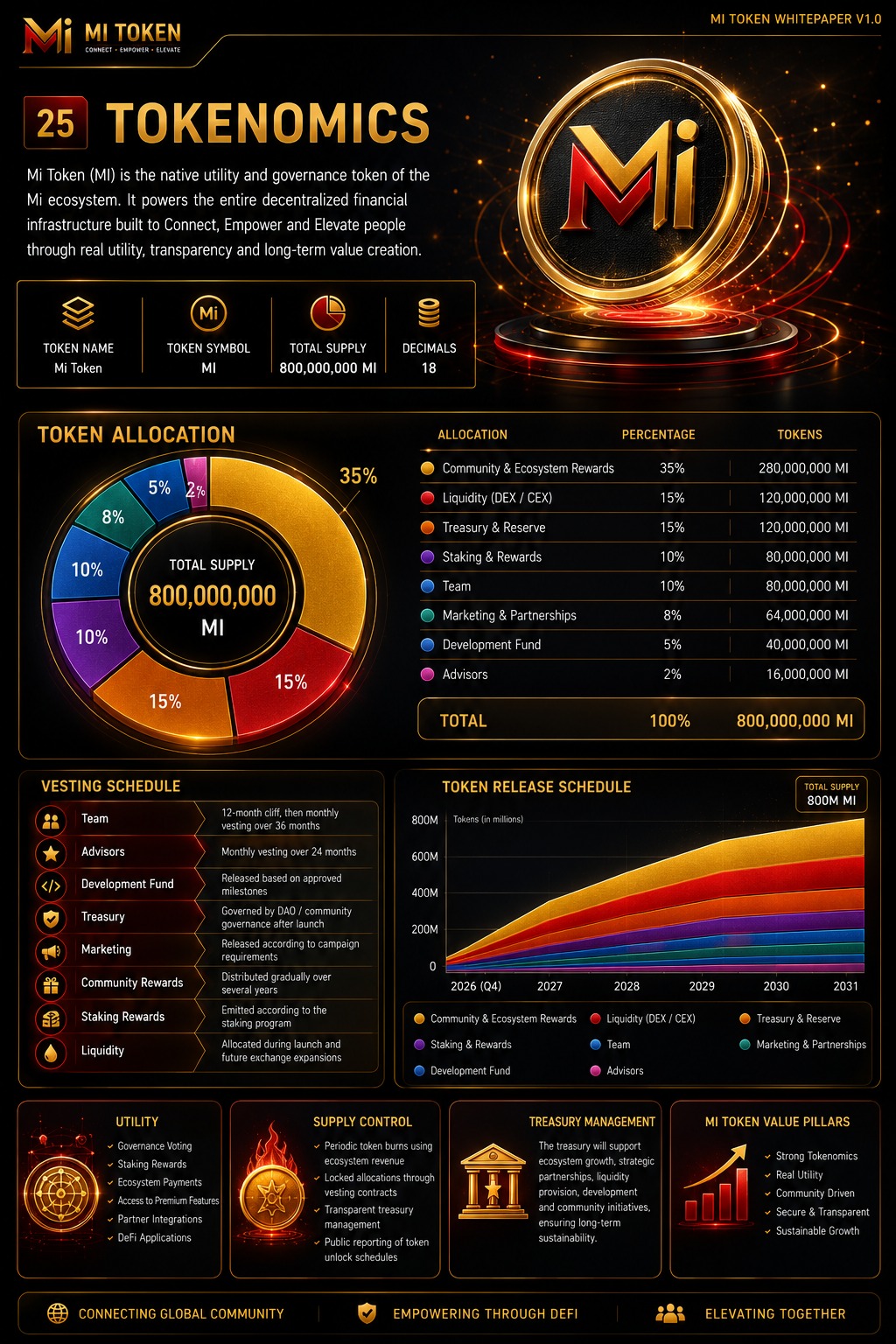
Tokenomics defines how supply, allocation, incentives, utility, and governance interact. A sustainable design should balance community access, ecosystem development, liquidity, team incentives, partnerships, treasury reserves, and long-term growth.

The final maximum supply, initial circulating supply, allocation percentages, vesting schedules, emission policy, and any burn mechanism remain to be confirmed. This draft intentionally does not invent these figures.

Once finalized, tokenomics should include a supply table, allocation chart, vesting timeline, unlock schedule, treasury policy, and clear explanation of any mechanisms capable of changing circulating supply.

Implementation Notes


Final implementation parameters must be validated against deployed smart contracts, independent audits, governance approvals, and applicable legal requirements. Technical specifications in future revisions should include verified contract addresses, network identifiers, role permissions, upgrade controls, and public repositories where applicable.
Distribution should reduce avoidable concentration risk and align long-term contributors with the ecosystem’s development horizon. Team, advisor, strategic, and ecosystem allocations should use transparent vesting where appropriate.

Vesting contracts can enforce cliffs and gradual unlocks on-chain. Public disclosure of material allocation wallets and unlock schedules can help the community evaluate future supply changes.

No allocation percentages are asserted in this version because the project’s approved figures have not yet been provided.
A long-term cross-chain strategy may allow Mi Token users to access applications across multiple compatible networks. Cross-chain expansion should occur only after the core deployment is stable and a clear user need exists.

Interoperability introduces additional risks. Bridges and messaging protocols can create complex trust assumptions and have historically been significant attack surfaces. Each integration should therefore be evaluated independently.

Canonical token representation, liquidity fragmentation, bridge security, and governance authority must be carefully managed to avoid duplicate or unauthorized token representations.
Future ecosystem expansion may include NFT and broader Web3 partnerships where they create genuine utility. Potential applications include membership credentials, digital rewards, loyalty programs, community access, creator collaborations, or token-gated experiences.

Partnership announcements should distinguish exploratory discussions from signed integrations. Technical integrations should be evaluated for security, user benefit, and sustainability.

The project should avoid adding features solely because they are fashionable; ecosystem modules should have a clear role in the broader Mi Token strategy.
Long-term ecosystem sustainability requires transparent sources of operational funding. Potential sources may include application fees, partner services, protocol integrations, treasury-managed ecosystem programs, or other disclosed revenue mechanisms, subject to legal and governance review.

No specific revenue stream should be represented as guaranteed. Fees must be disclosed clearly before users interact with a product.

Treasury sustainability, development costs, security expenses, liquidity requirements, and community incentives should be modeled together rather than treated as independent budgets.
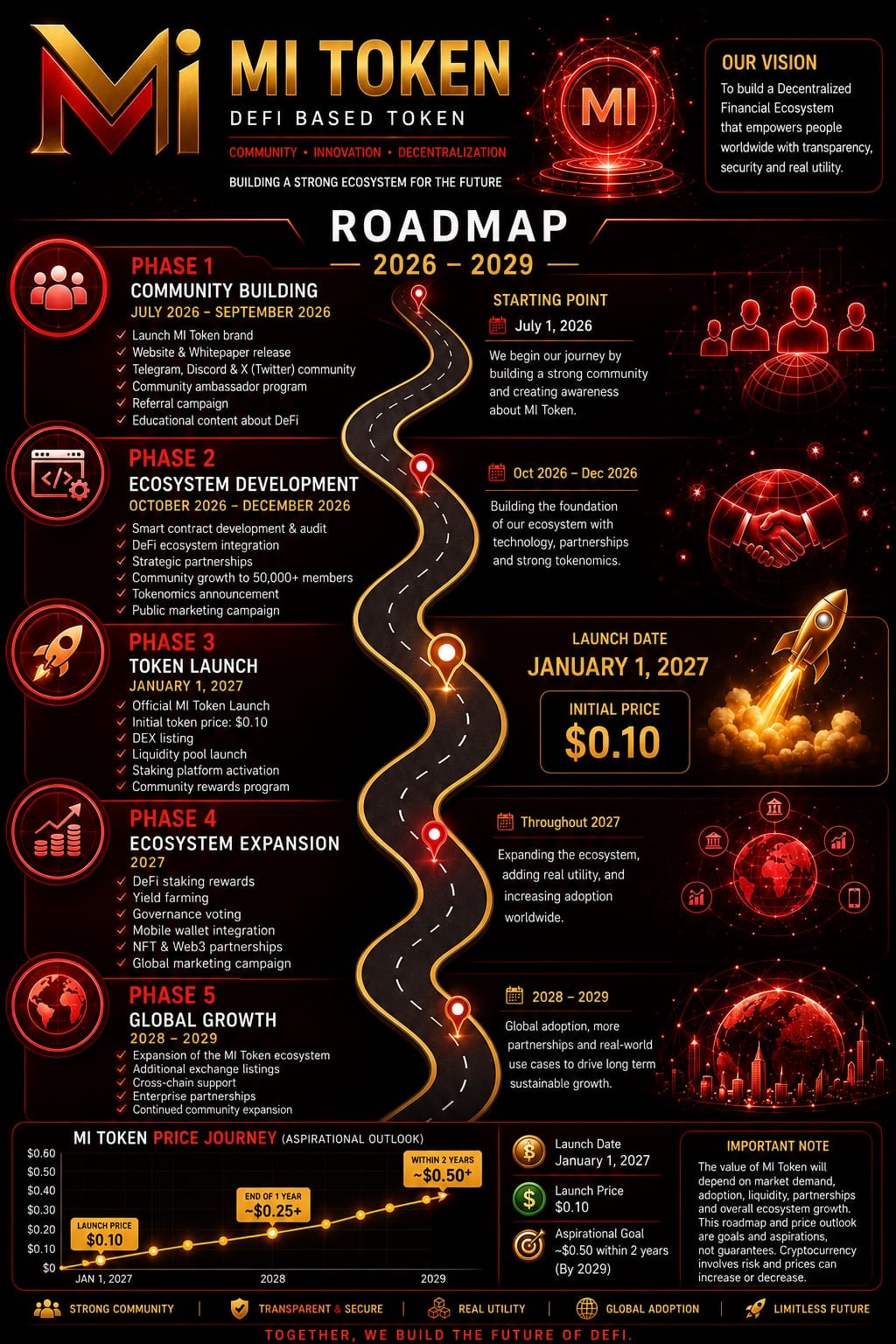
Mi Token places community development at the beginning of its roadmap. The initial phase, scheduled from July through September 2026 in the supplied roadmap, focuses on brand launch, website and whitepaper publication, community channels, ambassador activity, referrals, and DeFi education.

Community growth should emphasize informed participation rather than price speculation. Educational content can cover wallet safety, blockchain fundamentals, DeFi risks, governance, and responsible interaction with smart contracts.

Metrics should prioritize active and retained participants, product usage, governance engagement, and ecosystem contribution—not merely follower counts.

Phase 1


Community Building (July–September 2026): Mi Token brand development, website and whitepaper release, social/community channels, ambassador and referral programs, and DeFi education.

Phase 2


Ecosystem Development (October–December 2026): proposed smart-contract development and audit, DeFi ecosystem integration, strategic partnerships, community expansion, tokenomics publication, and public marketing.

Phase 3


Target Token Launch (January 1, 2027): the supplied roadmap identifies a target official launch, an illustrative initial price of $0.10, DEX listing objectives, liquidity pool activation, staking activation, and community rewards. These are roadmap targets and remain subject to technical, legal, market, and operational readiness.

Phase 4


Ecosystem Expansion (2027): staking and DeFi integrations, governance development, wallet integration, NFT/Web3 partnerships, and broader ecosystem marketing.

Phase 5


Global Growth (2028–2029): broader adoption, additional integrations and potential listings, cross-chain support, enterprise partnerships, and continued community expansion.

The supplied promotional roadmap includes an aspirational price journey, including a $0.10 launch reference and higher future targets. Such figures must not be presented in this whitepaper as forecasts, promises, guaranteed returns, or expected investment performance.

Digital-asset prices are determined by market conditions, liquidity, adoption, supply and demand, regulation, security events, macroeconomic factors, and many other variables outside the project’s control.

Accordingly, any price illustration should be clearly labeled as purely aspirational or omitted from investor-facing technical documentation. Mi Token does not guarantee appreciation or any particular market value.
Blockchain regulation differs across jurisdictions and continues to evolve. Mi Token should obtain qualified legal advice before token issuance, public sale, exchange distribution, staking deployment, marketing, or offering services that may trigger financial-services obligations.

Depending on jurisdiction and functionality, requirements may involve securities laws, virtual-asset regulation, anti-money-laundering controls, taxation, consumer protection, sanctions compliance, privacy, advertising rules, and licensing.

This whitepaper is informational and technical in nature. It should not be treated as legal, tax, financial, or investment advice.
Participation in digital-asset ecosystems involves substantial risk. Relevant risks include token price volatility, loss of liquidity, smart-contract vulnerabilities, wallet compromise, phishing, governance attacks, regulatory changes, bridge exploits, third-party dependency, oracle failures, operational failures, and loss of private keys.

Roadmap items may be delayed, changed, replaced, or discontinued. Proposed integrations may not launch. Exchange listings cannot be guaranteed. Staking rewards, if introduced, may change.

Users should conduct independent research and assess whether interacting with digital assets is appropriate for their circumstances.
Mi Token’s development approach should follow five principles: security before speed; utility before speculation; transparency before complexity; interoperability where useful; and progressive decentralization where technically and legally appropriate.

These principles provide a framework for evaluating future features. A feature that increases complexity without meaningful user benefit should not automatically be adopted.

Technical documentation should be updated as deployed systems evolve so that the whitepaper does not become a substitute for current contract documentation.
Trust in decentralized ecosystems depends on verifiable information. Mi Token should publish official contract addresses, audit reports, material governance decisions, token allocation information, vesting schedules, and relevant treasury disclosures when available.

Official communication channels should be clearly identified. Users should verify announcements and contract addresses before transacting.

Official communication channels should be clearly identified. Users should verify announcements and contract addresses before transacting.
Beyond the 2026–2029 roadmap, Mi Token may explore additional decentralized applications, merchant or partner utility, improved governance tooling, cross-chain connectivity, analytics, community identity systems, and integrations with emerging Web3 infrastructure.

Future expansion should be driven by measurable demand and sustainable economics. New products should undergo security, legal, and operational review before public deployment.

The ecosystem’s long-term objective is to evolve from a token-centered community into a utility-centered network of interoperable applications and partnerships.

Blockchain


A distributed ledger maintained by a network of participants.

DeFi


Decentralized Finance; financial applications implemented using blockchain and smart contracts.

DEX


Decentralized Exchange; a smart-contract-based venue for exchanging digital assets.

DAO


Decentralized Autonomous Organization; a governance framework that may coordinate proposals and voting through blockchain-based mechanisms.

Liquidity


Assets available to facilitate trading or other protocol operations.

Smart Contract


Program deployed on a blockchain that executes defined logic.

Staking


Locking or committing eligible digital assets under defined rules, potentially in exchange for protocol-defined benefits.

Tokenomics


The supply, distribution, incentive, utility, and economic design of a token ecosystem.

Vesting


A schedule that restricts when allocated tokens become transferable or available.
Mi Token’s proposed journey begins with community and education, progresses through technical development and security review, and targets a broader decentralized ecosystem over subsequent phases.

Mi Token’s proposed journey begins with community and education, progresses through technical development and security review, and targets a broader decentralized ecosystem over subsequent phases.

Connect. Empower. Elevate. Building the future together.
This document is a conceptual and technical whitepaper and does not constitute an offer to sell, solicitation to buy, prospectus, investment recommendation, financial advice, legal advice, or guarantee of future performance.

Statements concerning future products, launch dates, listings, staking, partnerships, cross-chain support, governance, prices, adoption, or ecosystem growth are forward-looking objectives and may change without notice.

Cryptographic tokens and decentralized applications involve significant risks. Prospective participants should conduct independent due diligence and obtain appropriate professional advice. Final token parameters, contractual rights, deployed addresses, legal structure, and jurisdiction-specific restrictions must be confirmed through official documentation before any token distribution or launch.

How It Works?

Bitcoin Mining is a peer-to-peer computer process used to secure and verify bitcoin transactions—ayments from one user to another on a decentralized network.

Download a Wallet

Bitcoin is received, stored, and sent using software known as a Bitcoin Wallet. Download the official Bitcoin Wallet for free.

Safe & Secure

We take careful measures to ensure that your bitcoin is as safe as possible. Offline storage provides an important security measure against theft or loss.

Buy & Sell

Blockchain works with exchange partners all around the world to make buying bitcoin in your wallet both a seamless and secure experience.

A Better User Interface

Bitcoin Core wallet has features most other wallets don't have. But if you don't need them, you can use several other wallets on top of Bitcoin.

Tokenomics

The supply, distribution, incentive, utility, and economic design of a token ecosystem.

Roadmap

The use of crypto-currencies has become more widespread, and they are now increasingly accepted as a legitimate currency for transactions.

Contact With Us

Mi Token is envisioned as a community-centered decentralized finance ecosystem designed around accessibility, transparency, user participation, and practical digital utility.

  • Email-id

    support@mitoken.live

Follow Us